
CIVIC SQUARE’s historic land purchase for the community
Apr 2024
“One of the biggest challenges was that philanthropy is not very ambitious in the UK. Funding is not very ambitious,”
says Imandeep Kaur, co-founder and director of CIVIC SQUARE. She continues:
“Wealth holders and funders take these incredibly large pots of money and put them into small, little programmes to keep people on these treadmills. That’s absolutely not what we need.”
In a landmark achievement for our sector, CIVIC SQUARE recently purchased their Birmingham site with the support of the Good Ancestor Movement community.
Interview with CIVIC SQUARE’s Imandeep Kaur
Our conversation with Imandeep is taking place at the height of Birmingham’s refuse collector strike. This reality lingers in the air throughout the conversation:
“The bins are being collected in the richer areas, but in the poorer areas rubbish is piled up – no exaggeration – in mountains, absolute mountains,” Immy describes.
“Then you’re coming into a week of heavy rains, and you’ve got children with the worst health outcomes, living in the worst quality housing, playing over their Easter holidays in that literal shit show.”
Despite this putrid picture, Immy is insistent that this crisis is tiny in the context of global inequality and the climate emergency. It does, however, perfectly demonstrate the urgent need for the type of hyper-local organising that CIVIC SQUARE excels in.
The organisation builds imaginative neighbourhood-level infrastructure and community projects that address urgent social, ecological, and economic challenges. CIVIC SQUARE looks at how local people can collectively reshape their homes, streets, and entire neighbourhoods without extracting value in an exploitative way.
The purchase of the full freehold of their land – part of a former industrial estate on the canals in Ladywood – is a truly watershed moment. It will now be held into the future by the community.
“Being able to purchase the land outright means that we can start the journey of setting new rules, new ways of relating to the land,” Immy explains. “It’s removed the site from speculation, away from it being a commodity to earn money off, and started the journey towards a new model.”
The site holds a classroom where people can learn to build and repair sustainably. A micro-factory is also in the works. It will be a place where the community can experiment with bio-based materials – building materials that are derived from biological sources rather than from fossil fuels – and create open-source construction systems that allow people to digitally design and cut out the components of a small home. And it will be the base for the team’s ambitious retrofit project.
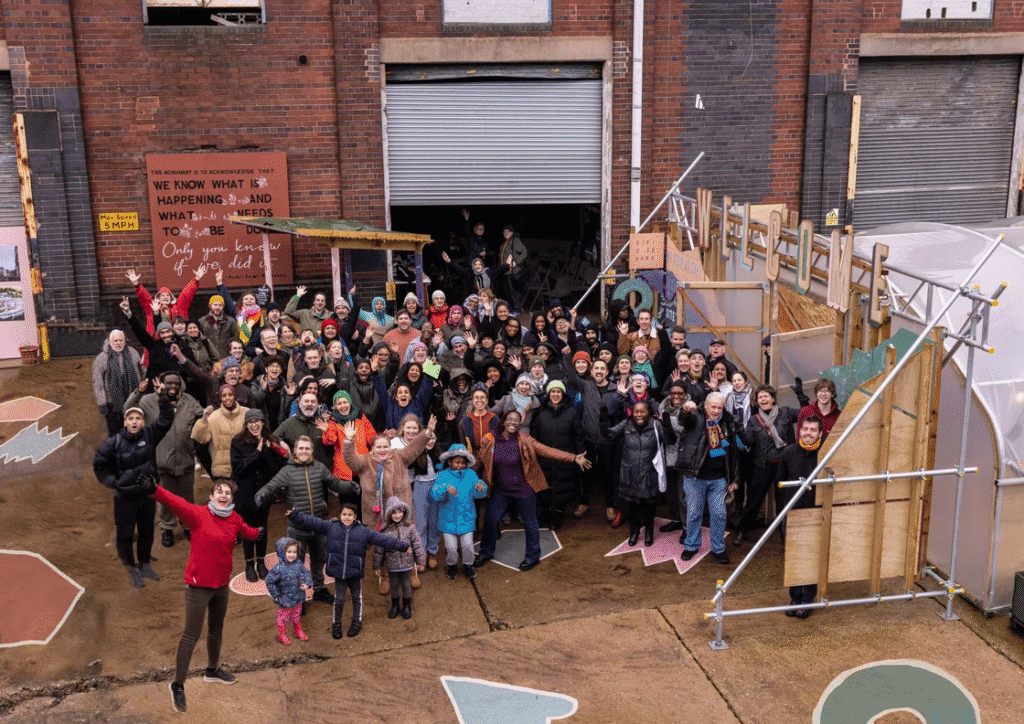
“We’re taking these huge, systemic ideas and putting them into practice at the scale of the home, the street, and the neighbourhood,” says Immy. “We’re really bringing the neighbours to the forefront of that story.”
This approach is what brought the Good Ancestor Movement and CIVIC SQUARE together, years before achieving what hasn’t before been done in our sector – the purchase of land to hold in perpetuity by a radical, community-led organisation.
“When we visited CIVIC SQUARE in Birmingham,” remembers Good Ancestor Movement’s CEO Stephanie Brobbey, “it struck us how the former industrial site on the waterways had connections to slavery and colonial violence. We really understood that acquiring the land was a major step towards the bigger vision.
“In summer 2024, we found out CIVIC SQUARE had only a short window to exercise their option to buy their land. We set about organising and talking to wealth holders in our community.”
Things moved fast as two wealth-holders offered to provide repayable grants. Catalytic capital was also unlocked by Tudor Trust. Incredibly swift legal support came from Barbara Eze and Sung-Hyui Park ensuring the process was completed in just 8 weeks.
“We wouldn’t have been able to do this without the foundation of mutual respect, solidarity and love for the work and for each other,” Stephanie emphasises, echoing sentiments also shared by Immy.
“In the UK, we still have a window to work in a different way,” Immy says, “and we have a huge responsibility to resource reparatively everywhere we can. But there’s a very big difference in resourcing work propositionally and just dealing with emergency response.”
Immy brings up the topic of the refuse worker strike again as an example:
“Birmingham’s going to be in the middle of a public health crisis, on top of an infrastructure crisis, on top of a bankruptcy crisis.
“And that is the future of many cities, unless we can really deeply invest […] in neighbourhood community resilience work. Work that will help to rebuild our streets and neighbourhoods from the ground up.”
Keep up with CIVIC SQUARE’s work on their Neighbourhood Public Square blog.